Cluster headaches, so called because they have a tendency to appear in time "clusters", are an excellent candidate for craniosacral therapy because they involve all the cranial and facial bones, as well as the sutures that connect them, and the connective tissue (sutures are a form of connective tissue), such as the meninges of the brain, and the fascia that envelops, and weaves through, the muscle tissue.
What causes cluster headaches?
There are numerous theories regarding the etiology of cluster headaches. One that has not been seriously considered is the shifting of cranial bones after trauma to the head, or anywhere along the spine. Let's look at the symptoms of cluster headaches and then build a case for "shifting of headbones" (or facial bones) as a possible cause of cluster headaches.- Unilateral stabbing, boring, lancinating, relentless pain mostly behind the eye, around the eye, and the temple
- Tearing of the eye
- Runny nose
- Redness of the conjunctiva (the white around the eye)
- Drooping eyelid
- Constricted pupil
- Facial flushing, sweating, and swelling on the side of the pain.
Cluster headaches not only involve the head bones (cranial bones) but also the facial bones.
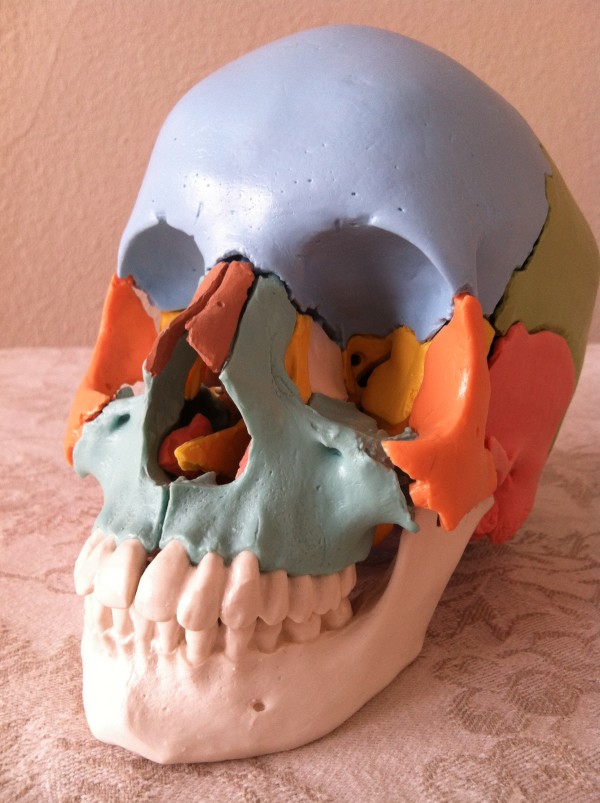
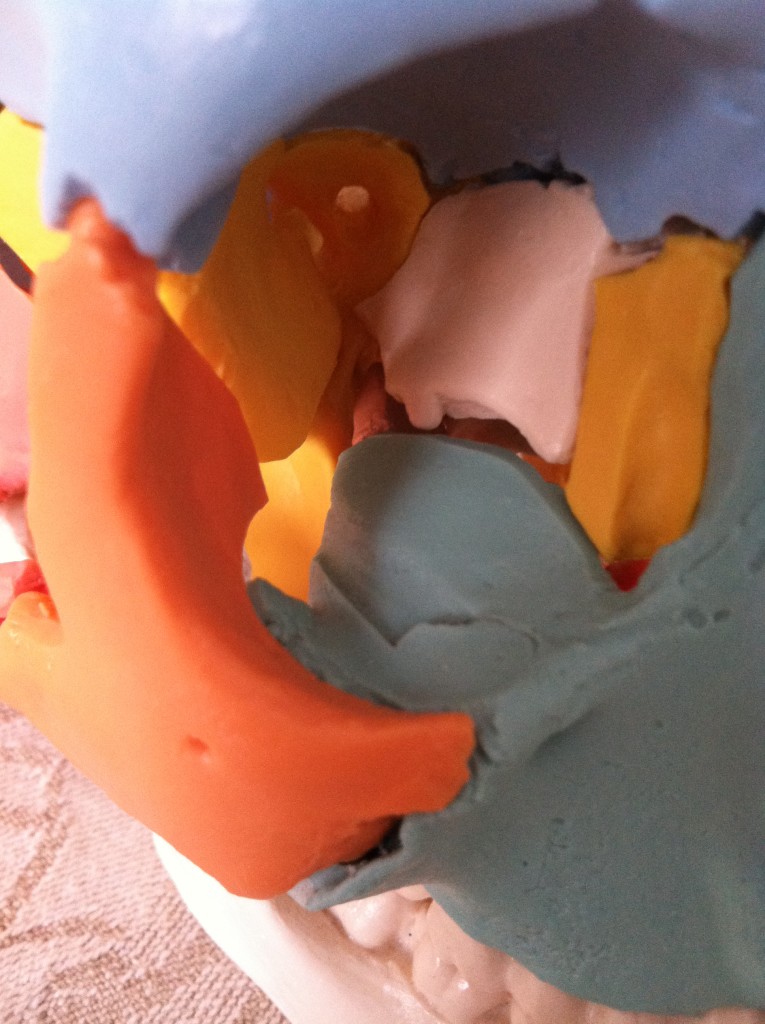 Most of the pain appears to involve the frontal bone (light blue), the zygomae (peach), the maxillary bones (aqua), and the temporal bones (green). However, most frequently, the pain is centered in the orbit of the eye (eye socket), which is actually composed of many bones. These are the
- frontal bone (cranial)
- lacrimal bone (facial) -- yellow, in front of the white bone
- zygomatic bones (facial)
- maxillary bone (facial)
- palatine bone (facial) -- barely visible, in corner formed by the sphenoid, maxillary, and ethmoid bones
- sphenoid (cranial) -- yellow, in center of head, behind ethmoid bone
- ethmoid bone (cranial/facial) -- white bone
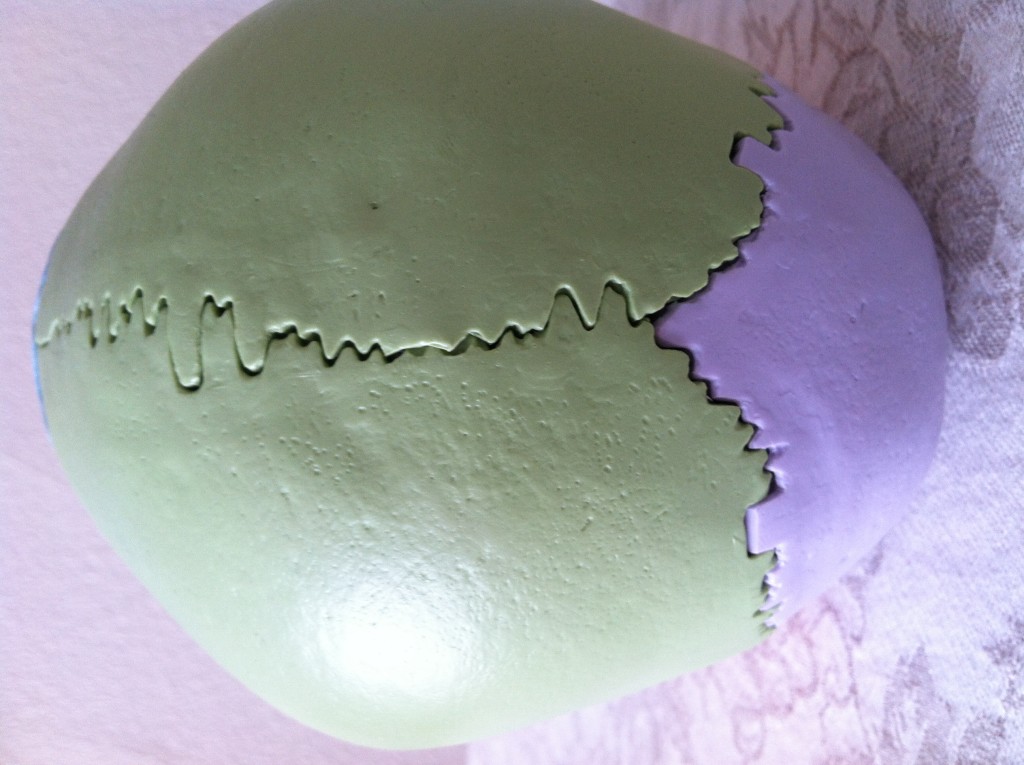
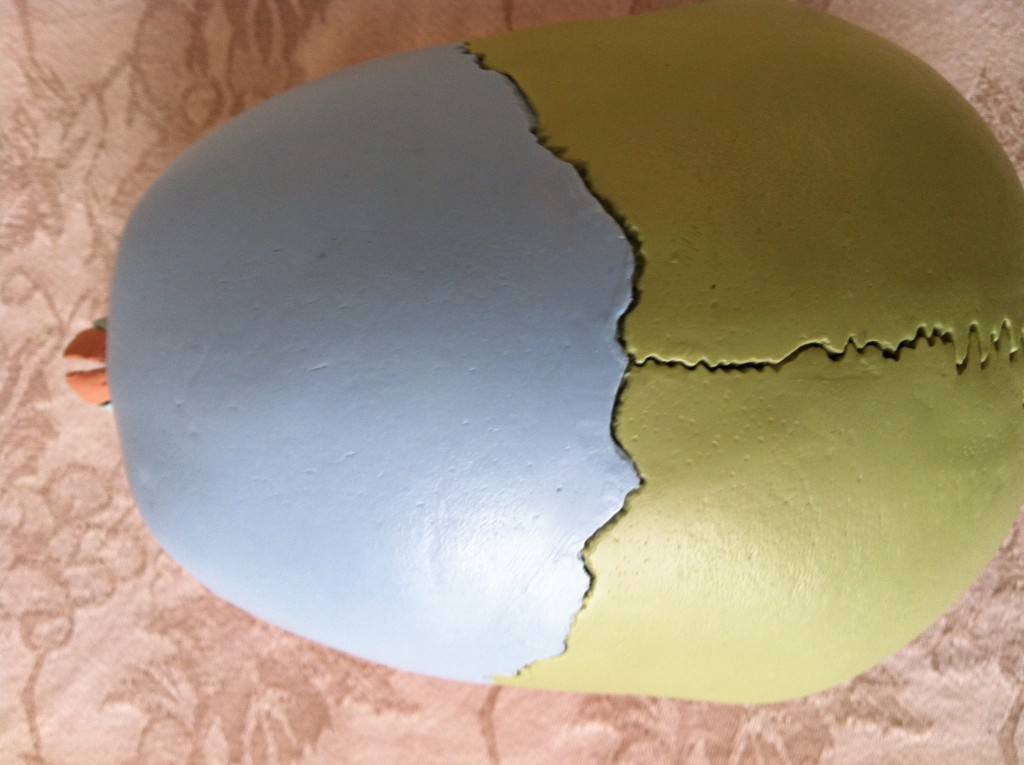
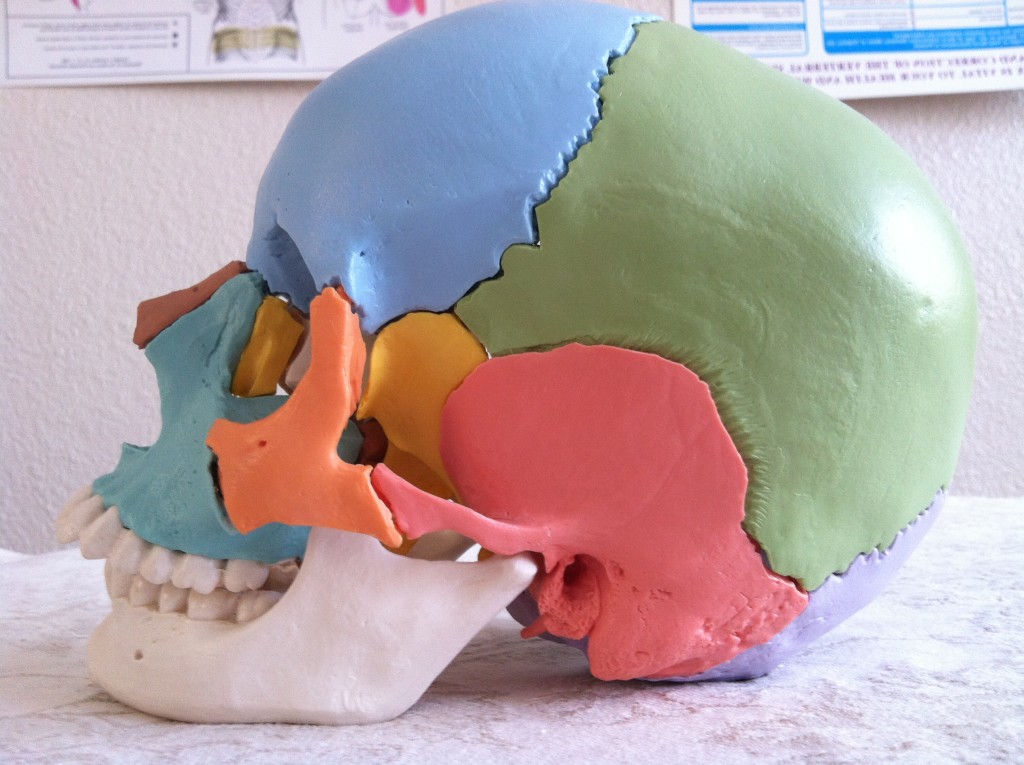
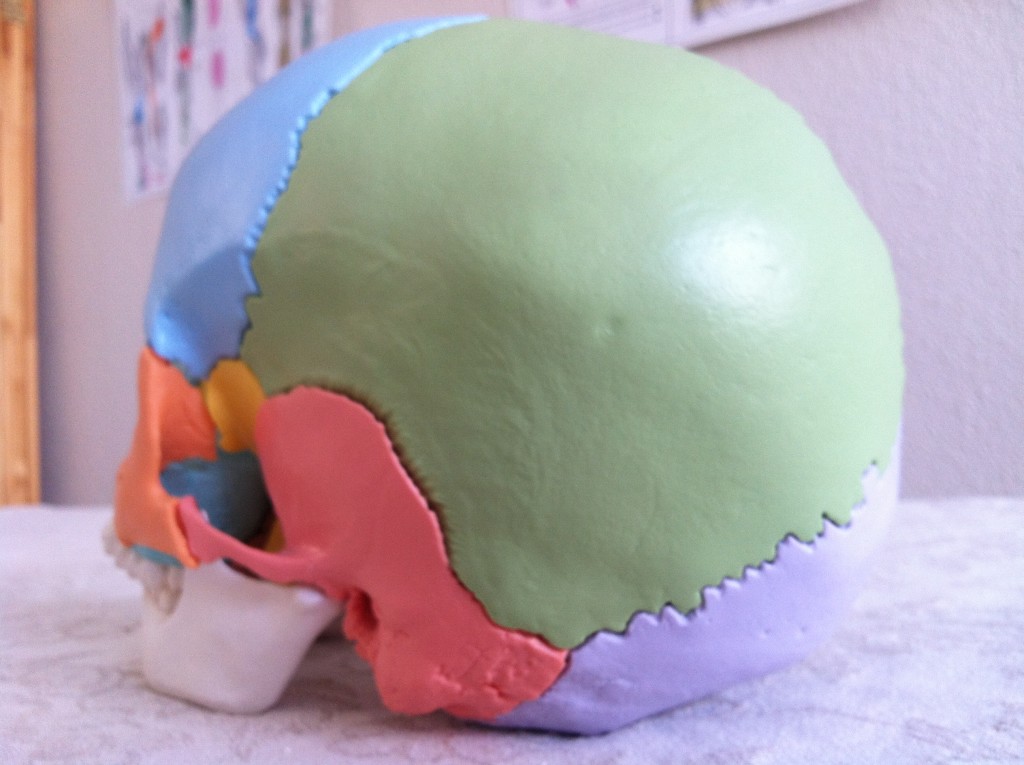 Fontanelles are the places where several of the headbones meet up. One is the lambda (posterior fontanelle), which joins the occipital bone (lavender) with the two parietal bones. Another one is the bregma (anterior fontanelle -- major soft spot in newborns), which joins the frontal bone with the parietal bones. On either side of the head at the temple, we have the pterion, which joins the temporal bones (pink) with the parietal and frontal bones, as well as the sphenoid (yellow). Last but not least, behind the ears we have the asterion (by the mastoid process), which joins the occipital bone with the parietal and temporal bones.
All the head bones (1 frontal bone, 2 temporal bones, 2 parietal bones, 1 sphenoid, and 1 occipital bone) are connected via the sutures. These head bones shift all the time as they adjust to the pressures and pulls arising from our body movements via the muscular and connective tissue. When the head bones lock up anywhere along the sutures, or in the fontanelles, we experience all sorts of symptoms, including cluster headaches.
Fontanelles are the places where several of the headbones meet up. One is the lambda (posterior fontanelle), which joins the occipital bone (lavender) with the two parietal bones. Another one is the bregma (anterior fontanelle -- major soft spot in newborns), which joins the frontal bone with the parietal bones. On either side of the head at the temple, we have the pterion, which joins the temporal bones (pink) with the parietal and frontal bones, as well as the sphenoid (yellow). Last but not least, behind the ears we have the asterion (by the mastoid process), which joins the occipital bone with the parietal and temporal bones.
All the head bones (1 frontal bone, 2 temporal bones, 2 parietal bones, 1 sphenoid, and 1 occipital bone) are connected via the sutures. These head bones shift all the time as they adjust to the pressures and pulls arising from our body movements via the muscular and connective tissue. When the head bones lock up anywhere along the sutures, or in the fontanelles, we experience all sorts of symptoms, including cluster headaches.
The fontanelles are inherently unstable.
We could use the analogy of earthquakes. The fontanelles are major earthquake centers. The sutures are the fault lines. Just as the tectonic plates of the earth move all the time, so do the cranial bones (head bones or skull bones). When the tectonic plates overlap and get stuck, the earth tries to shake them loose via an earthquake. The quality of the earthquake is in part governed by the location and type of abuttment (like the sutures of the head) between the tectonic plates. So it is with the cranial bones. The fontanelles are particularly vulnerable to shifting of the cranial bones because they are areas where several cranial bones join together. Hence, if one of these bones gets stuck in some way, so do the rest. This means that the jarring of one of these bones is transmitted to all the other bones, and the "earthquake" thus spreads to more distant parts of the head, including the face. Moreover, since the cranial bones are also connected via sutures to the facial bones, trauma of any kind to the head or the face, as well as anywhere along the spine all the way down to the sacrum (and coccyx -- tail bone), may register in any part within this craniosacral system (from the cranium down the spine to the sacrum).Head trauma and locking up of the cranial bones can injure the pituitary gland.
The pituitary gland, often referred to as the master gland and regulates all the hormonal functions of the body. Moreover, it has feedback mechanisms to the hypothalamus and the limbic system (emotional brain). These feedback loops explain the emotional component of the hormonal system.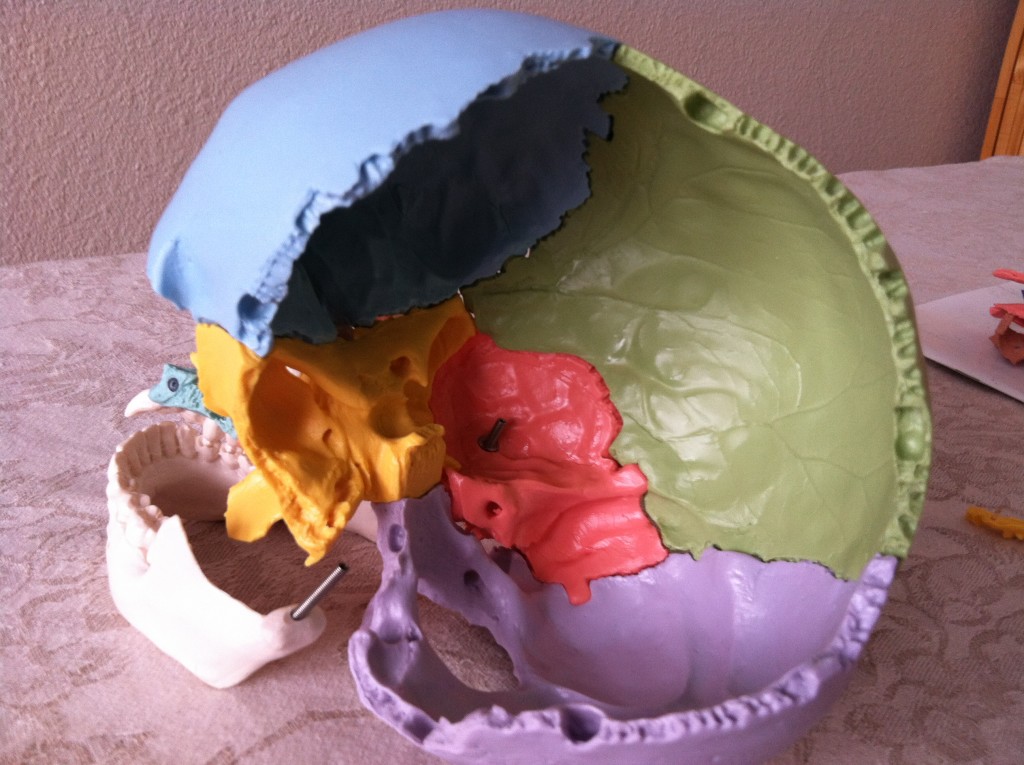 The pituitary gland is a pea sized organ that is located in the sella turcica (Turkish saddle), a small indentation in the body of the sphenoid (yellow bone), inside the head, almost in a straight line down from the bregma and in a straight line from the root of the nose between the eyes into the center of the head. (the image above only shows the sella turcica, not the pituitary gland)
Trauma to the head or face may cause the sphenoid to shift, lock up, or create meningeal tension on the sphenoid that may result in over- or underfunctioning of this all important gland. This explains some of the many different symptoms experienced with headaches, including cluster headaches.
Various symptoms may give a clue that the pituitary is involved, such as
The pituitary gland is a pea sized organ that is located in the sella turcica (Turkish saddle), a small indentation in the body of the sphenoid (yellow bone), inside the head, almost in a straight line down from the bregma and in a straight line from the root of the nose between the eyes into the center of the head. (the image above only shows the sella turcica, not the pituitary gland)
Trauma to the head or face may cause the sphenoid to shift, lock up, or create meningeal tension on the sphenoid that may result in over- or underfunctioning of this all important gland. This explains some of the many different symptoms experienced with headaches, including cluster headaches.
Various symptoms may give a clue that the pituitary is involved, such as
- thermoregulation
- thirst and urinary issues
- fatigue or impaired metabolism
- issues with fertility and sexual function
- mood changes
- difficulty with focus and memory
- lactation issues